Is Travel in Morocco Safe? The Complete ElitTrip Guide for Every Traveler Going Alone
The question you are really asking is not a statistical one. You already suspect Morocco is probably fine. What you actually want to know is this: what will it feel like to be there — specifically, alone — and will that feeling be manageable? This guide answers that question honestly, completely, and without the sanitized reassurance that leaves you more anxious than before you started reading.
Table of Contents
The One Sentence That Changes Everything
Here is the honest truth that most headlines miss: Morocco is safe, but it is annoying. The danger in Morocco is not usually physical safety — it is financial safety through scams and emotional safety through persistent hassle.
Read that again. Sit with it. Because once you understand it — truly understand it, not just intellectually but viscerally — your entire relationship with Morocco as a travel destination shifts. The traveler who arrives braced for violence will exhaust themselves scanning for threats that, in all likelihood, are never going to materialize. The traveler who arrives understanding that the real friction is social, predictable, and manageable shows up with tools that actually match the challenges in front of them.
Morocco ranks 24th globally on the World Safety Index — ahead of countries like Portugal, Sweden, and the Netherlands. Over 18 million tourists visited in 2025 without major incidents. That number is not a marketing claim. It is a reflection of a country that has invested deeply in tourist safety infrastructure, not because it is altruistic, but because tourism contributes over 7% of Morocco’s GDP and the government has powerful, structural, financial incentives to keep visitors safe.
The U.S. State Department currently rates Morocco as Level 1 — Exercise Normal Precautions — the lowest possible travel advisory rating available. This means the U.S. government considers Morocco as safe to visit as most popular European destinations, including France, Spain, and Italy. Yahoo!
None of this means Morocco is frictionless. It means the friction is a specific, manageable, well-documented kind — and that this guide is going to give you everything you need to handle it.
Why Morocco Feels Scarier Than It Is — And Why That Gap Matters
A lot of confusion comes from what people read online. Small uncomfortable moments are sometimes described as serious danger. Real safety and feeling uncomfortable are not the same thing.
This is the gap that trips up more Morocco-bound travelers than any actual safety issue in the country. A bad experience with a persistent vendor in the Fes medina becomes a Reddit post titled “Almost Scammed in Morocco.” A frustrating taxi negotiation in Marrakech becomes a warning shared in every solo travel Facebook group. These experiences are real. They are also not the whole story — and the speed at which they travel through online communities has created a perception of danger that bears almost no relationship to the statistical reality of what happens to the millions of people who visit every year.
Many solo travelers arrive nervous and leave feeling stronger and more confident. Morocco can be challenging in the beginning, but it also teaches awareness and self-confidence. For those who are prepared and open-minded, solo travel Morocco safety here is not only possible — it is often deeply rewarding.
The travelers who have the hardest time in Morocco are almost always the ones who conflated discomfort with danger before they arrived. That conflation is the single most self-defeating thing you can bring to this country — more damaging than any scam, more exhausting than any vendor, because it colors every interaction from the moment you land.
The Actual Risks: Named Precisely, Not Minimized
The Faux Guide and the Medina Scam Ecosystem
The “Faux Guide” phenomenon is the number one scammer issue in Morocco. An unlicensed person will try to offer you directions, tell you that a monument is closed, or offer to take you to their family’s shop for a commission. The most famous example is the Fes Tannery Trick — someone approaches you in the maze-like Fes medina and says the tanneries are closed for prayer or cleaning, but follow them to their brother’s leather shop for the best view. They then pressure you to purchase something expensive.
Understanding how this works before you encounter it is the entire defense. The tanneries are not closed. The monument is not closed. The “shortcut” leads to a shop. This is a documented, predictable, completely avoidable scenario that only works on travelers who haven’t been told it exists. You have now been told it exists. Walk past with a calm la shukran and keep moving.
Friendly helper and fake guide scams are more common in Marrakech and Fes than in smaller towns. For most tourists, higher alert usually means more scams and petty theft, not serious danger. Google
The rule that neutralizes most of this with a single decision: arrange any guides through your riad or a verified tour operator in advance. A licensed local guide costs relatively little, adds extraordinary cultural depth, and removes the entire category of unsolicited guide risk from your day. The ten minutes of advance arrangement is always worth it.
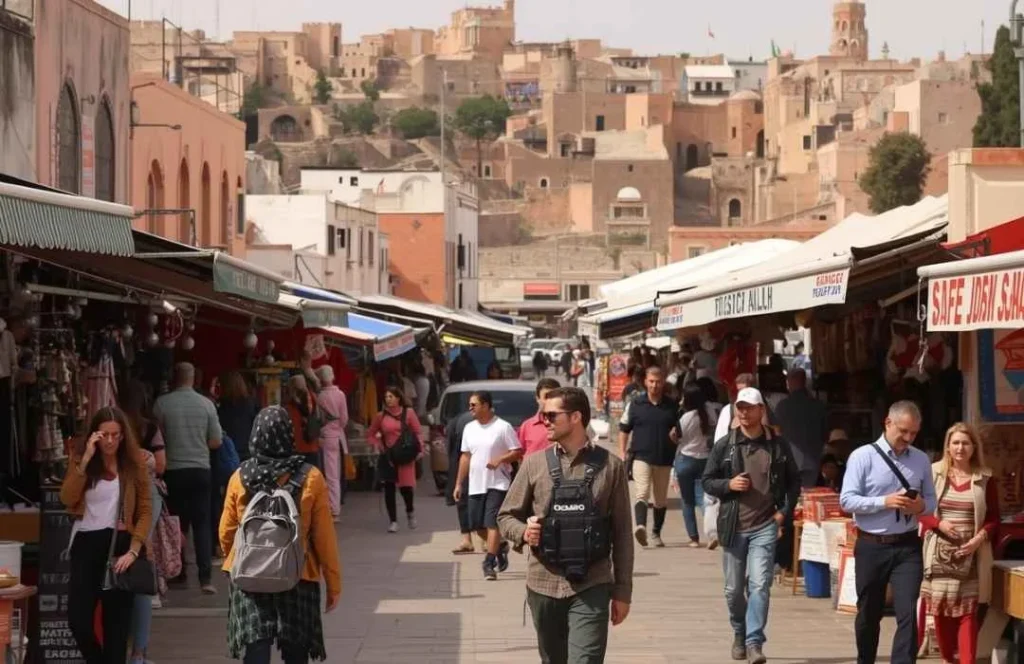
Petty Theft in Crowds
Morocco has a relatively low crime rate overall, but tourists should keep alert and watch their valuables at all times. Avoid poorly lit areas, don’t travel alone at night in unfamiliar areas, and watch your belongings carefully.
The practical structural solution for petty theft is exactly that — structural. Wear a crossbody bag positioned in front of your body rather than a backpack. Carry only the cash you need for the day and leave excess in your riad’s safe. Keep your phone in a front pocket rather than a back one, and put it away when you are moving through crowded souk areas rather than using it while walking. These are not anxious precautions. They are sensible habits that take thirty seconds to adopt and eliminate most theft risk entirely.
Be particularly vigilant around ATMs — only use machines in busy, well-lit areas and cover the keypad with your hand to protect your PIN. Carry small dirham notes for tipping and small purchases so that paying for things doesn’t require displaying large amounts of cash in public.
Cyber Scams: The Risk Nobody Mentions
Cyber scams are something to watch for in Morocco. Make sure you are on a legitimate Wi-Fi network before connecting to the internet. Riad and hotel Wi-Fi is generally reliable and trustworthy. Public networks in cafés and markets are less so. Use a VPN on any public network, and avoid accessing banking applications on any connection you haven’t verified. Download Google Maps offline before you leave your accommodation each morning — this gives you full navigation capability without needing to connect to any external network at all.
The Road: Morocco’s Most Underreported Risk
Morocco’s roads are statistically more dangerous than its crime rate. The biggest risk to your safety in Morocco is traffic accidents, not crime or terrorism. Book tours with professional drivers.
Driving in Morocco’s larger cities is semi-organized madness best reserved for locals and experts. Roads are not well-marked and drivers often practice unsafe driving behavior. Drive defensively and make sure your rental car is insured. Avoid driving at night — the roads are poorly lit in the countryside, making car-animal accidents a real danger.
For solo travelers navigating the southern routes — the approach to Merzouga through the Drâa Valley, the Atlas Mountain passes, the desert tracks near Erg Chebbi — the correct approach is a vetted driver arranged through your accommodation rather than self-driving. The additional cost is modest. The reduction in risk is not.
Political Demonstrations
Political and social demonstrations are frequent in Morocco and are rarely confrontational or violent. Travelers should avoid demonstrations and move away from gathering crowds as soon as possible. Be extra-vigilant at events that attract large crowds. Yahoo!
The practical response is simply movement. If you encounter a demonstration forming, redirect your route. These are not targeted at tourists and do not represent a danger to visitors who are not present in the immediate area. Check local news briefly each morning during your trip — not because something is likely, but because awareness costs nothing.
Is Travel in Morocco Safe at Night?
This question gets a more nuanced answer than most guides provide, because the answer is genuinely different depending on which city you are in, which neighborhood you are walking through, and what time it is.
Evenings in medinas are generally fine. Stick to busy, well-lit areas after 10pm. Morocco’s tourist police are quick to respond if needed.
From local experience guiding travelers, the people who feel safest at night are the ones who stay calm, move with confidence, and do not overthink small situations. Moroccan evenings are social, not threatening, and once travelers understand that, night walks, cafés, and city squares often become highlights of the trip.
The practical framework for nights in Morocco: the modern districts of major cities — Gueliz in Marrakech, the Ville Nouvelle in Fes, central Rabat — are comfortable to walk in after dark in the same way that any European city center would be. The deeper lanes of the historic medinas after 10pm are a different proposition — not because they are dangerous, but because they are poorly lit, quiet, and harder to read. Use Uber, Bolt, or a riad-arranged taxi for any substantial evening journey. Staying in well-reviewed riads, using apps for transport, and keeping valuables secured makes for a smooth evening experience.
Is Travel in Morocco Safe for Tourists From Western Countries?
The vast majority of the millions of tourists who visit Morocco every year — including solo female travelers, families, couples, and first-time visitors — experience absolutely no safety issues whatsoever. Like any destination in the world, Morocco has areas and situations that require common sense awareness — but overall it remains one of the safest and most rewarding travel destinations available to international tourists today.
For American travelers specifically: Morocco and the United States have the longest continuous diplomatic relationship of any U.S.–African nation pair, dating back to 1777. The Moroccan government invests heavily in tourism security, with tourist police — the Brigade Touristique — present in major cities and the country having not experienced a major terrorist attack targeting tourists in over a decade.
For travelers from the UK, Canada, and Australia: the advisory levels vary slightly in wording — the UK FCDO advises standard caution, Canada notes general safety with specific regional awareness, Australia advises a high degree of caution — but none of these advisories categorize Morocco as a destination to avoid. Morocco is not generally treated like a do-not-travel destination by any major government. It is typically categorized as open with caution, similar to many popular countries where petty crime and situational awareness matter.
City by City: What Safety Actually Feels Like on the Ground
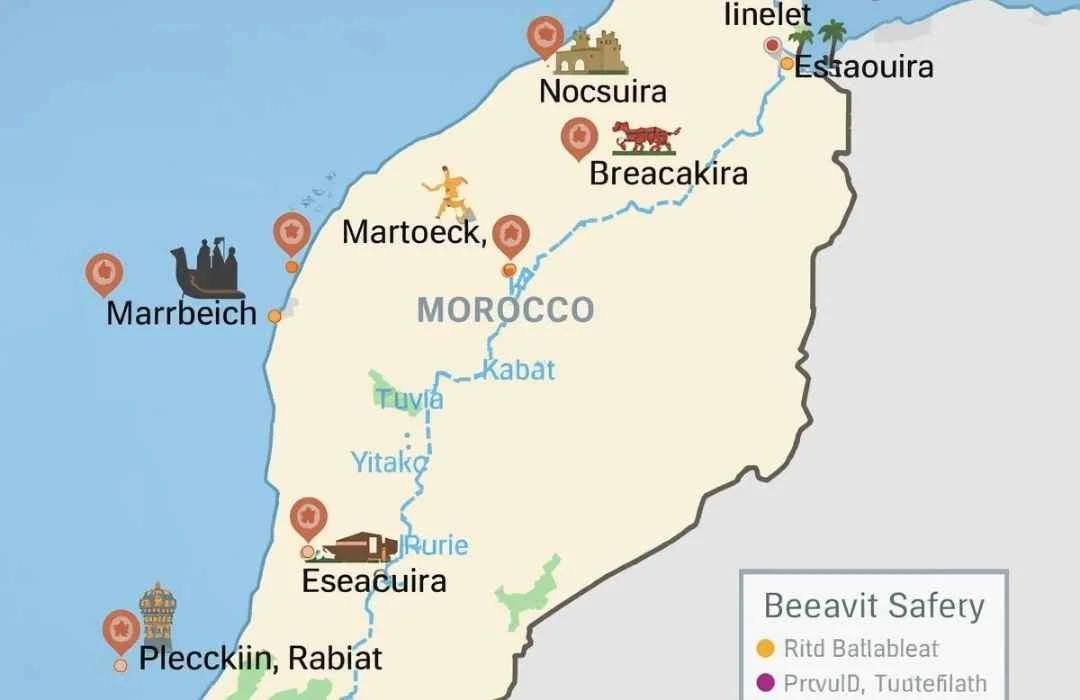
Marrakech
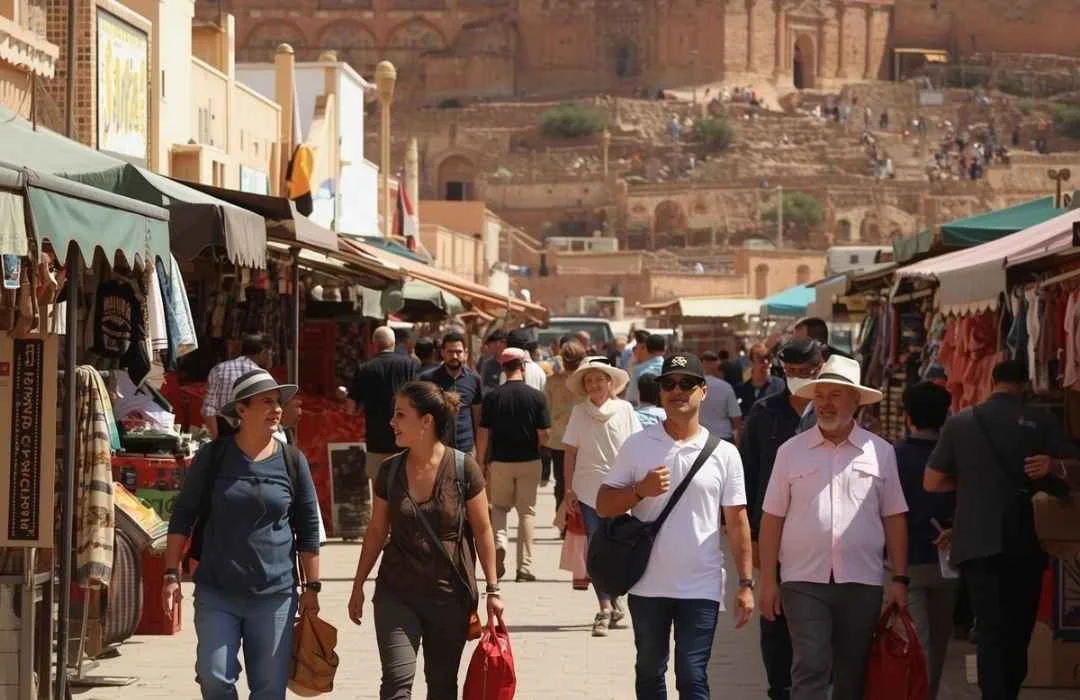
The Moroccan government takes tourist safety extremely seriously in Marrakech, with dedicated Brigade Touristique tourist police in the medina and heavy penalties for crimes against visitors. The real challenges are vendor pressure in the souks and the persistent unsolicited guide culture near the major monuments. Neither is dangerous. Both are manageable within the first day once you understand how they work.
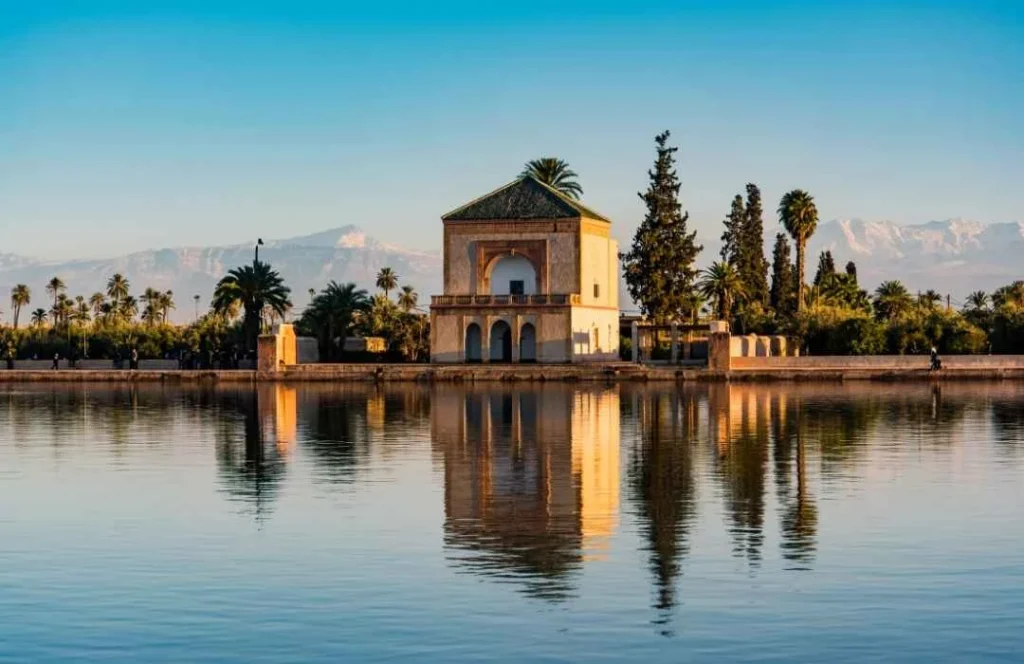
Base yourself in Gueliz — the modern district outside the medina walls — if the medina’s intensity feels like too much in the evenings. Use Uber for any journey after dark. Treat the medina as a daytime destination and give yourself two full days before forming any final impression of the city, because Marrakech almost always becomes significantly more manageable once you understand its rhythm.
Fes
The medina demands your most active awareness of any city in Morocco — 9,000 lanes, minimal signage, and the highest concentration of unsolicited guide approaches in the country. Download offline maps of Fes before arriving — Moroccan medinas are notoriously difficult to navigate and offline maps can save hours of confusion. Arrange a licensed guide for your first full day through your riad. Return alone on the second morning with the city’s layout in your head and the knowledge of what to decline — and Fes opens up into one of the most extraordinary travel experiences available anywhere in the world.
Chefchaouen
Chefchaouen is extremely popular with international travelers and considered very safe — relaxed, photogenic, and tourist-friendly. TravelAge West The compact medina, the mountain setting, the gentle pace — all of it makes Chefchaouen the city where safety feels least like something you need to think about and most like something that is simply ambient. For first-time visitors to Morocco, starting here before moving to the imperial cities is one of the most strategically sound decisions you can make.
Essaouira
Essaouira is coastal, laid-back, and arts-focused — one of the most relaxed destinations in Morocco for solo travelers. TravelAge West The compact medina, the Atlantic ramparts, the working fishing harbor — none of it asks anything difficult of you. The vendor pressure that defines Marrakech and Fes is reduced to a level most solo travelers describe as barely noticeable. For the traveler who needs the trip to begin gently, Essaouira is the right answer.
Rabat
Morocco’s capital delivers the full cultural depth of the imperial cities — historic medina, extraordinary monuments, authentic daily life — at a fraction of the social friction. The city’s tram system provides reliable, safe public transport that connects major neighborhoods without the taxi negotiation that creates vulnerability elsewhere. The vendor pressure that characterizes Marrakech and Fes is almost entirely absent — Rabat functions primarily as a government and residential city, and its relationship with visitors is one of mild curiosity rather than commercial intensity.
Casablanca
Casablanca is Morocco’s economic capital and largest city. Moroccans and travelers alike need their big-city awareness switched on — watch for muggings and petty theft including phone snatching. Casablanca lacks the medina charm of Marrakech and Fes and is best used as a transit point rather than a base for solo travelers. If your flight arrives or departs from Casablanca’s Mohammed V Airport, spend the minimum time necessary and move on to destinations that reward slower travel.
Transport Safety: The Complete Picture for Solo Travelers
Trains are the safest and most reliable intercity option in Morocco. The Al-Boraq high-speed train connecting Casablanca with Tangier is particularly good. Book first-class where the price difference is minimal — the additional comfort and reduced crowding makes a meaningful difference on longer journeys.
Buses from CTM and Supratours are reliable, safe, and widely used by international travelers for routes trains don’t cover. Book tickets in advance for popular routes during peak spring travel season.
City taxis require two simple rules: agree on the fare before getting in, or insist the driver uses the meter. Agree on price or insist on the meter for city taxis. Ask your riad to call a taxi rather than hailing from the street — the accountability this creates changes the dynamic from the start.
Ride apps — Bolt and inDrive are available in major Moroccan cities and represent the safest and most transparent transport option for solo travelers — metered, traceable, and without the fare negotiation that creates vulnerability when you are tired or unfamiliar with local pricing. Download both before you arrive. Use them as your default after dark.
Desert tours — The Merzouga and Sahara region is remote but safe for organized tours. Avoid self-driving into the deep desert without an experienced local guide. Book through your riad or a verified operator with a physical address and recent reviews from solo travelers specifically.
Cultural Awareness as a Safety Tool
When people ask if Morocco is safe, they often compare it to their home country. But safety in Morocco works in a different way. It is not only about crime numbers — it is about knowing what behavior is normal, how people talk to each other, and how public places function. Once you understand that, many situations that look worrying at first stop feeling like a problem.
The cultural practices that make the biggest practical difference to your daily experience as a solo traveler:
Dress modestly in medinas and traditional areas — loose clothing covering shoulders and knees measurably reduces unwanted attention and demonstrates the genuine respect that Moroccan hospitality responds to with warmth rather than pressure. In beach resorts and riads, dress codes are naturally more relaxed.
Ask permission before photographing people. Avoid entering mosques restricted to non-Muslims. Be mindful that Friday morning is a religious time — expect slower movement and closed businesses in traditional areas.
Learn five phrases in Darija before you land: la shukran (no thank you), shukran bezaf (thank you very much), besh hal (how much), safi (enough/that’s fine), and labas (how are you/I’m well). Using these is not performance. It signals genuine respect for where you are, and Morocco responds to that signal with a warmth that changes the entire texture of daily interactions.
Carry cash in Moroccan dirhams — many medina shops, taxis, and smaller riads do not accept cards. Carry small notes for Morocco safety tips and minor purchases.
What Travelers Who Go Alone Actually Say
After 23 years and over 6,000 clients, the most dangerous part of Morocco is how much you will miss it when you leave. By staying alert in crowded areas, respecting local customs, and having the right information before you go, Morocco becomes one of your favorite travel memories. As one traveler perfectly summed it up: “We have traveled the world by way of backpacking to luxurious cruises and we can both honestly say that Morocco will forever be one of our favourite destinations.”
That is the arc of almost every solo traveler who prepares well and goes with realistic expectations. Not frictionless. Not easy. Deeply, lastingly worth it.
Travelers who come without a guide often say they felt stressed during the first days, then relaxed later once they understood how things work. From local experience guiding travelers, the people who feel safest are the ones who stay calm, move with confidence, and do not overthink small situations.
The confidence is not something you bring to Morocco. It is something Morocco gives you — slowly, across several days, through the accumulation of situations you navigated and discomforts you moved through and moments where you found yourself handling something you weren’t sure you could handle. That is what a solo elite trip to Morocco is actually made of.
Practical Pre-Departure Checklist for Every Solo Traveler
Before you land, do these five things:
Register your trip with your government’s traveler enrollment program — in the US, this is STEP at step.state.gov. Free, five minutes, ensures the embassy knows you are in the country if anything genuine occurs.
Download offline maps of every city you will visit before landing. Moroccan medinas are notoriously difficult to navigate and offline maps can save hours of confusion and eliminate the need to stand in the middle of a souk staring at your phone.
Get a local SIM card at the airport the moment you clear customs. Reliable data means reliable navigation, reliable ride-hailing, and reliable emergency contact. This is not optional for a solo traveler.
It is a good idea to have vaccinations for Hepatitis A and wash your hands regularly. Carry oral rehydration sachets in case of traveler’s diarrhea — the number one health complaint among visitors to Morocco. Drink only bottled or filtered water throughout your trip.
Save the Tourist Police number (19) and the general emergency number (15) in your phone before you leave your accommodation on the first morning. You are unlikely to need them. Having them takes thirty seconds and removes the category of uncertainty that makes minor incidents feel more serious than they are.
FAQ: What Solo Travelers Ask Before Booking
Is travel in Morocco safe for first-time international travelers?
Yes. Morocco is welcoming, stable, and rich with experiences that are hard to find anywhere else in the world. The precautions you need in Morocco are no different from those you would take in Paris, Rome, or Bangkok — stay aware, use common sense, and trust reputable services. The country’s massive tourism industry, dedicated tourist police, and legendary Moroccan hospitality mean that the vast majority of visitors leave with nothing but incredible memories.
Is Morocco safe for solo travelers going without any group?
The vast majority of travelers who visit Morocco — including solo female travelers, families, couples, and first-time visitors — experience absolutely no safety issues. Hundreds of thousands of independent travelers explore Morocco solo every year, and the country’s well-established tourism infrastructure is built with exactly this traveler in mind.
Are there areas of Morocco solo travelers should avoid entirely?
The Western Sahara region and areas near the Algerian border carry higher caution advisories. Most tourist itineraries do not involve these zones — the Erg Chebbi dunes near Merzouga are in a different region entirely and are entirely safe for organized visits. For most solo travelers following a standard Morocco itinerary, none of the country’s genuinely cautious zones are on the route.
What is the single most effective thing I can do to stay safe in Morocco?
Arrive informed. The most dangerous part of Morocco is how much you will miss it when you leave. After following simple rules — staying alert in crowded areas, respecting local customs, and having the right support — Morocco becomes one of your favorite travel memories. Everything in this guide is the preparation that makes that outcome overwhelmingly likely.
Final Thought: The Version of You That Boards the Return Flight
There is a traveler who reads every safety guide about Morocco, absorbs every warning, catalogues every scam, and decides the friction is too much — and spends the trip in a state of vigilance that prevents them from experiencing the country at all.
And there is a traveler who reads this guide, understands the real risks clearly and without exaggeration, arrives prepared with the right tools for the right challenges, and discovers — somewhere around day three, in a medina café with a glass of mint tea and a city that has started to make sense — that the uncomfortable thing and the dangerous thing are not the same thing, and that they are capable of navigating both.
The question is not really whether Morocco is safe. The question is which part of Morocco you will explore first. The Manual
A solo elite trip to Morocco does not promise you easy. It promises you real. And the traveler who has been reading this at midnight, talking themselves into and out of booking — you already know the difference between those two things, and which one you actually came looking for.
Go. Go prepared. Come back knowing yourself better than when you left.
ElitTrip is built for travelers who go alone. Read our complete Morocco Solo Travel Guide, our honest breakdown of the safest cities in Morocco for solo travelers, our dedicated guide for women traveling alone in Morocco, and our full guide to solo travel safety for every type of independent traveler.
you’ll also love this :
- Is Morocco Safe for Solo Travelers? The 2026 Truth
- Morocco Solo Travel Guide: The ElitTrip Honest Guide for Travelers Who Go Alone
- Is Morocco Safe for Women Travelers ?
- Safest Cities in Morocco for Solo Travelers: The Honest Ranked Guide
Want to Share Your Experience?
Have you traveled using one of our guides or found inspiration here?
👉 Share your experience in the comments or send us your story
Your insights help other travelers plan more thoughtful, rewarding journeys.
Latest Reviews
There are no reviews yet. Be the first one to write one.